


Home Services Digital Marketing:
The Complete Guide to Generating More Leads in Google and AI Search
WSI Digital is a top‑ranked WSI agency serving businesses across Texas and the U.S. with strategies backed by a global network of AI and SEO experts.
Executive Summary
Home service companies are facing a major shift in how customers search, evaluate, and choose providers. Traditional SEO and paid ads still matter, but they are no longer enough on their own. Today, homeowners discover companies through Google rankings, Maps, reviews, AI-generated answers, voice search, and mobile-first experiences.
This guide explains what modern home services marketing should include, how Adaptive SEO changes the game, what channels matter most, and how to build a system that drives more qualified leads, stronger visibility, and more predictable revenue.
In this guide, you will learn:
- How homeowners search for home services today
- Why traditional SEO alone is no longer enough
- What the home services revenue system looks like
- Which digital marketing channels matter most
- How Adaptive SEO helps companies show up in Google, Maps, and AI search
- What high-performing home service companies do differently
- Which home service sub-verticals need specialized strategies
- What mistakes commonly limit lead flow and growth
WSI DIGITAL:
Serving Home Services Companies across Texas and the U.S.
Home service companies compete in some of the most location-dependent search environments in digital marketing. Whether you serve one metro or multiple markets, the companies winning online are the ones with a structured, multi-channel digital presence — not just a website.
How Homeowners Search for Home Services Today
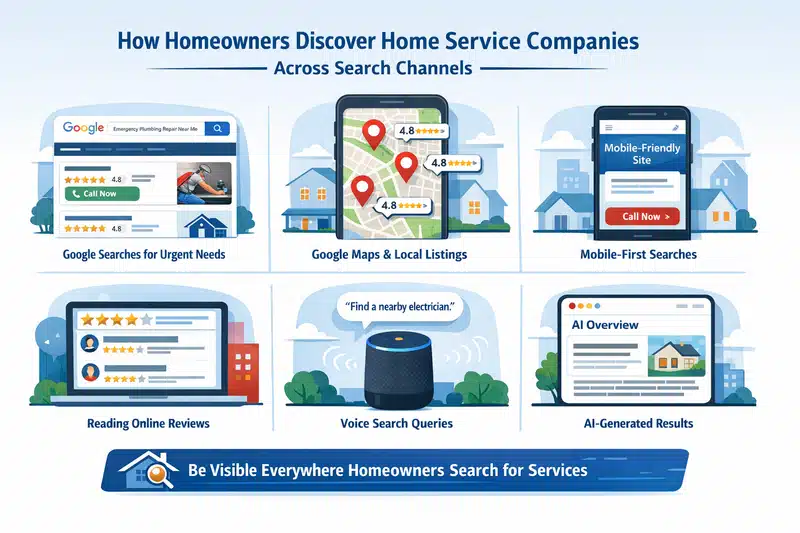
Some searches happen through traditional Google results. Others happen in Maps, voice assistants, review platforms, or AI-generated answers. Homeowners also compare providers through local search visibility before ever making contact.
Today’s search behavior often includes:
- Google searches for urgent service needs
- Google Maps and local pack listings
- Mobile-first search behavior
- Review comparison across providers
- Voice search for fast answers
- AI-generated results through Google AI
- Overviews and other platforms
DID YOU KNOW?
Key Home Services Search Statistics
Before contacting a single contractor, 98% of homeowners check online reviews first — making review volume and star rating the first filter in most hiring decisions.
Local mobile searches convert fast — 76% lead to a business visit within 24 hours and 28% end in a purchase, making mobile-first visibility critical for home service companies.
According to Google Trends data, “near me” searches related to home services have grown over 200% in the past few years, driven largely by smartphone usage and voice search.
For home service companies, this means your visibility in Google Maps, local pack results, and AI-generated answers is just as important as your organic search rankings.
Why Traditional Digital Marketing Is No Longer Enough
For years, many home service companies relied on referrals, SEO, and Google Ads. Those channels still matter, but the environment has changed.
Search engines are surfacing more answers directly. AI is changing how information is delivered. More homeowners are deciding who to contact before ever visiting multiple websites.
Search is changing. Buyers are getting answers without clicking. If you want to understand how that shift is impacting strategy, start with how AI Overviews are changing click behavior and SEO strategy.
That means:
- Visibility happens directly in search results
- Maps and reviews influence decisions before site visits
- AI-generated summaries shape consideration
- Weak content structures reduce visibility
WSI EXPERT INSIGHT:
What We See in Competitive Home Services Markets
The home service companies that come to us most frustrated are typically doing one or two things well — maybe they run Google Ads, or they have decent reviews — but they have no system tying it all together.
The shift to AI search is real and happening now. Google AI Overviews are appearing for a growing share of home services queries. If your content is not structured for AI visibility, you are losing position to competitors who have adapted.
The good news: most home service companies have not yet made this shift. That creates a significant window of opportunity for companies willing to invest in their digital presence today.
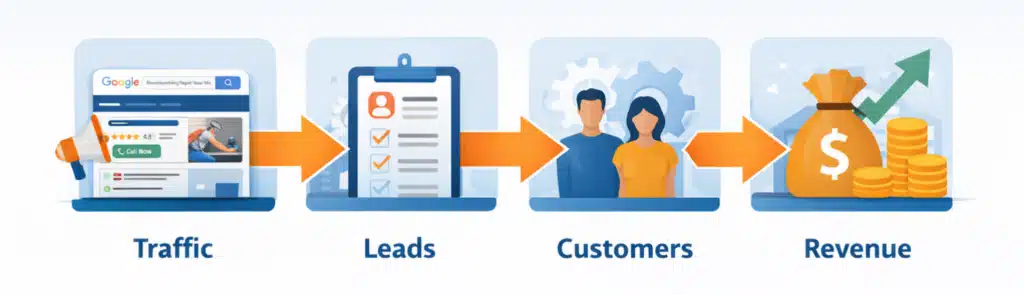
The Home Services Revenue System
If any part weakens, growth becomes unpredictable.
A strong system includes:
- Consistent traffic acquisition
- Strong conversion paths
- Effective follow-up
- Repeat service opportunities
- Brand trust and authority
The goal is not just traffic. The goal is revenue.
PRO TIP:
Track Every Lead Source
If you do not know which marketing channel is driving your phone calls and form submissions, you cannot optimize your ad spend or SEO investment. Set up:
- Call tracking software (such as CallRail or WhatConverts) to attribute calls to specific campaigns
- UTM parameters on all paid and campaign URLs
- Goal completions in Google Analytics 4 tied to form submissions and calls
- Google Search Console to monitor organic search performance
Without this tracking infrastructure in place, you are flying blind — and overpaying for results you cannot measure.
Core Digital Marketing Channels for Home Services Companies
Search Engine Optimization
SEO builds long-term visibility for high-intent searches.
Your SEO approach should include:
- Service page optimization
- Service area pages
- On-page SEO
- Technical SEO
- Internal linking
- Content strategy
- Local SEO
Learn more about SEO services and local SEO — and for a deeper look at the signals that drive local search rankings, this guide is worth a read.
LOCAL SEO FOCUS:
Competing in Your Most Important Markets
Competitive metro markets require a localized SEO strategy that goes beyond ranking for your city name. In your top markets, your strategy must account for:
- Keyword research and competitive gap analysis mapped to each city and service type you offer, so your content targets exactly how local homeowners in your markets search
- City-specific landing pages for each major city you serve
- Google Business Profile optimization for every service area location
- Competitor gap analysis to identify ranking opportunities your competitors are missing
- Content targeting market-specific search terms and seasonal demand patterns (e.g., summer HVAC demand, spring storm season for roofing, winter freeze events)
WSI Digital builds this local content framework for home service companies across their most important markets — so you rank in the cities and regions that drive the most revenue for your business.
Website Design and Development
Your website is your conversion engine.
It must:
- Load fast
- Be mobile-first
- Build trust immediately
- Convert visitors efficiently
Conversion Rate Optimization
More traffic does not fix poor conversion.
Focus on:
- Messaging clarity
- Strong CTAs
- Reduced friction
- Trust signals
- Mobile usability
Learn more about CRO and landing page optimization.
Marketing Automation and Lead Nurturing
Not all leads convert immediately.
This includes:
- Email follow-ups
- Quote reminders
- Review automation
- Reactivation campaigns
Explore marketing automation.
Google Ads and Paid Search
Paid search drives immediate demand capture.
This includes:
- Emergency service campaigns
- Service-specific ad groups
- Call-first landing pages
- Geo targeting
- Conversion tracking
Explore search engine marketing, PPC, and predicting local Google Ads results.
GOOGLE LOCAL SERVICES ADS (LSAs):
The Most Underused Channel in Home Services
Google Local Services Ads are pay-per-lead ads that appear above all other Google results — above traditional PPC ads, above organic listings, and above the local pack. For eligible home service categories, LSAs consistently deliver some of the lowest cost-per-lead in digital marketing.
To qualify, companies must pass a background check and earn the Google Guarantee or Google Screened badge. This verification itself becomes a trust signal that improves conversion rates.
Key advantages of Google LSAs for home service companies:
- Pay only for valid leads (calls and messages from real customers)
- Top placement above PPC and organic results
- Google Guarantee badge builds immediate trust
- Simple, low-friction setup compared to traditional PPC campaigns
If your home service company is not running Local Services Ads, you are ceding the most visible real estate in Google search to competitors who secure the top position by paying per verified lead — not per click — with a Google Guarantee badge that builds trust before a homeowner ever visits their site.
Google Business Profile Optimization
Your Google Business Profile (GBP) is one of the highest-impact digital assets a home service company owns. It directly influences your visibility in Google Maps, the local pack, and increasingly in AI-generated search answers.
A fully optimized Google Business Profile includes:
- Complete service list with descriptions and pricing where applicable
- All service areas listed with accurate geographic boundaries
- Business hours including after-hours and emergency availability
- High-quality photos of your team, vehicles, work in progress, and completed jobs
- Active Q&A section with pre-populated questions and answers covering common customer queries
- Regular Google Posts featuring seasonal offers, completed projects, or company news
- Consistent review response — responding to every review (positive and negative) signals active engagement to Google
Set up or claim your profile at Google Business Profile.
GBP PRO TIP:
Reviews Drive Rankings and Conversions
Google Business Profile reviews directly influence your local pack ranking. Companies with more reviews, higher average ratings, and more recent reviews consistently outrank competitors with weaker review profiles.
We recommend implementing a systematic post-job review request process for every home service company we work with. A simple text message sent 24 hours after a completed job asking for a Google review can increase review velocity by 3-5x.
Target: 4.5+ star average with at least 50 reviews for competitive local markets. In major competitive markets, 100+ reviews may be necessary to compete for top local pack positions.
Adaptive SEO: How Home Services Companies Win in Google and AI Search
Traditional SEO helps you rank. Adaptive SEO helps you stay visible everywhere.
This includes:
- Google AI Overviews
- Maps
- Voice search
- Featured answers
- AI-driven search
Adaptive SEO focuses on:
- Entity authority
- Content structure
- Internal linking
- Trust signals
- Technical health
For deeper insight, see how Google’s AI impacts SEO and topic clusters.
AI VISIBILITY CHECKLIST:
Is Your Home Service Company Ready for AI Search?
Use this checklist to assess your current AI and local search readiness:
- Google Business Profile claimed, verified, and fully optimized (hours, services, photos, Q&A)
- Structured data / schema markup implemented on service pages (LocalBusiness, Service, FAQPage)
- NAP (Name, Address, Phone) consistent across all directories and citations
- FAQ sections included on service pages with question-and-answer format
- Service pages cover the full scope of each service with depth and specificity
- Google reviews averaging 4.0+ stars with regular, recent reviews being added
- Mobile page load time under 3 seconds (test at Google PageSpeed Insights)
- Internal linking connects service pages, area pages, and blog content
- Content written to answer specific homeowner questions, not just describe services
If you checked fewer than 6 of these, there is meaningful opportunity to improve your AI and local search visibility.
Marketing Strategies by Home Service Type

HVAC Companies
Seasonal demand, emergency service, and maintenance plans drive strategy.
HVAC is one of the most competitive home services categories in major U.S. markets. Seasonal demand spikes — driven by summer heat in the South and winter cold in the North — reward companies with strong, established visibility. A strong HVAC marketing strategy includes:
- Seasonal campaign timing: ramp up paid search and local visibility campaigns in April-May before peak summer demand
- Emergency service keywords: target high-urgency terms like ’AC not working’ and ’same-day HVAC repair’ with call-first landing pages
- Maintenance plan marketing: email and retargeting campaigns to convert one-time customers into recurring revenue through annual service agreements
- Location-specific service pages: separate pages for each city and major suburb served, optimized for local search
- Google Local Services Ads: essential for capturing emergency repair searches at the top of Google
- Review generation: HVAC companies with 4.5+ star ratings and 100+ reviews consistently outperform competitors in local pack rankings
In dense contractor markets like Houston, Dallas, and Phoenix, city-level SEO targeting is essential, not optional — consistent with the performance benchmarks tracked across the HVAC industry.
Storm-driven demand, trust, and reviews dominate.
In storm-prone markets across the South, Midwest, and Gulf Coast, roofing demand is heavily influenced by severe weather. Hailstorms, high winds, and hurricane seasons create sudden, high-volume demand windows that reward companies with strong, pre-established visibility. Key roofing marketing strategies include:
- Storm response campaigns: have paid search campaigns ready to activate immediately following storm events in your service area
- Insurance claim education content: homeowners navigating the insurance process search for guidance — companies that answer these questions build authority and capture early-stage leads
- Trust-building content: roofing involves significant investment and homeowner concern about contractor quality. Before-and-after project galleries, video testimonials, and detailed review profiles all reduce conversion friction
- Service area expansion pages: roofing companies typically serve wider geographic areas than many other trades — service area pages for each major city help capture regional search demand
- Financing offer pages: many homeowners need financing for large roofing projects — prominently featuring financing options on landing pages improves conversion rates
Storm-prone markets consistently generate the highest roofing activity in the country — making pre-established digital visibility the primary competitive advantage when demand spikes.

Plumbing Companies
Emergency visibility and call-first UX are critical.
Plumbing searches are among the highest urgency in home services. When a pipe bursts or a drain backs up, homeowners need a solution immediately — and the first company they can reach often gets the job. Key plumbing marketing strategies include:
- Call-first design: your website and landing pages must prioritize click-to-call above all other actions, especially on mobile
- Emergency service visibility: target ’emergency plumber near me,’ ’24-hour plumber,’ and similar urgency terms with dedicated landing pages
- Google Local Services Ads: for emergency plumbing, LSAs deliver top placement with the Google Guarantee badge — both critical trust signals when homeowners are stressed
- Service-specific pages: water heater replacement, drain cleaning, sewer line repair, and leak detection each deserve their own optimized service page
- Response time messaging: if you offer same-day or 2-hour response guarantees, feature this prominently — it is a primary decision factor for emergency searches
In markets with temperature extremes, plumbing demand spikes during winter freezes and periods of intense heat that accelerate pipe failures. Companies with established visibility before these events capture the highest volume of leads.

Electrical Contractors
Service clarity and trust matter most.
Electrical contractors face a unique marketing challenge: homeowners understand they need a licensed, trustworthy professional, but they struggle to differentiate between options. Marketing strategy must prioritize trust signals and service clarity:
- License and certification prominence: display your state electrical license, insurance, and certifications prominently on every landing page and in your Google Business Profile
- Service clarity pages: ’electrical panel upgrade,’ ’EV charger installation,’ ’generator installation,’ and ’home rewiring’ each represent different searcher intents — build dedicated pages for each
- Safety content: content that addresses electrical safety concerns helps establish authority and captures homeowners researching before they call
- Commercial vs. residential targeting: if you serve both markets, separate your marketing messaging and landing pages for each audience
- Google Business Profile optimization: reviews emphasizing professionalism, on-time arrival, and clean work are particularly important for electrical contractors

Pest Control Companies
Seasonality and urgency drive performance.
Pest control has strong seasonal patterns and high repeat purchase potential, making it ideal for a marketing system that combines acquisition campaigns with retention automation:
- Seasonal campaign timing: target specific pests by season — fire ants and mosquitoes in spring/summer, rodents in fall/winter — with campaigns that match search intent
- Subscription plan marketing: recurring treatment plans generate predictable revenue — landing pages and email campaigns should actively promote plan enrollment
- Pest-specific landing pages: ’termite inspection,’ ’mosquito control,’ ’bed bug treatment,’ and ’rodent removal’ each have distinct search audiences and should have dedicated pages
- Free inspection offers: pest control companies with free inspection CTAs consistently outperform those with generic ’contact us’ CTAs in conversion testing
In warm-climate markets, year-round pest activity creates more consistent demand than northern markets. Termites, cockroaches, mosquitoes, and fire ants generate particularly high search volume across Sun Belt metros.

Restoration and Mitigation Companies
Emergency trust and rapid response are key.
Restoration and mitigation companies operate in a category defined by urgency, insurance complexity, and emotional stress. Marketing must establish immediate credibility and reduce the friction of reaching you quickly:
- 24/7 availability messaging: if you offer round-the-clock response (and in this industry you should), this must be the first message a prospect sees
- Insurance process guidance: homeowners dealing with water damage, fire damage, or mold rarely understand the insurance claim process — content that guides them through it positions you as the trusted expert and captures early-stage searches
- Google Local Services Ads: emergency restoration is one of the highest-ROI categories for LSAs — homeowners in crisis need immediate reassurance that you are verified and trusted
- Certifications front and center: IICRC certification, EPA lead-safe certification, and similar credentials should appear on every key page
- Referral relationships: build digital content that positions you as a resource for real estate agents, insurance adjusters, and property managers who regularly refer restoration work

Garage Door and Specialty Services
Urgent demand and conversion speed matter.
Garage door services are highly transactional with short decision cycles. When a garage door fails, homeowners search, decide, and call within minutes. Marketing must prioritize fast visibility and immediate conversions:
- Same-day service messaging: if you offer same-day repair or installation, lead with this promise on all landing pages and in your Google Business Profile
- Service vs. replacement segmentation: homeowners searching for garage door repair have different intent than those searching for new garage door installation — separate landing pages improve both conversion and ad efficiency
- Brand pages: homeowners researching specific brands (LiftMaster, Chamberlain, Genie) represent high-intent prospects — brand-specific pages capture this traffic
- Google Local Services Ads: short decision cycles make garage door services ideal for LSA top-of-page placement
- Photo galleries: showing completed installations builds confidence and supports both organic search and social media content

Remodeling and General Contractors
Longer sales cycles require stronger nurturing.
Remodeling and general contracting involves longer decision cycles, higher average project values, and more complex trust-building. Marketing must support a multi-touch consideration process:
- Portfolio and project gallery pages: high-quality before-and-after galleries are the single most important trust-building asset for remodelers — invest in professional photography
- Project type pages: kitchen remodels, bathroom renovations, room additions, and whole-home remodels each attract distinct search audiences — build dedicated pages for each major service
- Lead nurturing sequences: remodeling leads often take 30-90 days from first contact to decision — email sequences that maintain contact and provide value during this period significantly improve close rates
- Financing content: large project financing is a key decision factor for many homeowners — prominently feature available financing options
- Houzz and Angi profiles: remodeling homeowners use platform-based research more than most other home service categories — maintain strong profiles on these platforms alongside your own website
- Video content: project walkthroughs, client testimonials, and behind-the-scenes content perform exceptionally well for remodelers across social media and YouTube
What High-Performing Home Service Companies Do Differently

Invest consistently in SEO.
High-performing companies treat SEO as an ongoing investment, not a one-time project. They add content, build authority, and improve their site structure continuously — which is why they hold top positions while competitors cycle in and out of rankings.

Use paid search strategically.
They run Google Ads with purpose: targeted campaigns for high-value services, call-first landing pages, conversion tracking tied to real leads, and budgets adjusted based on actual cost-per-lead data — not gut feel.

Build strong service pages.
Every core service has its own dedicated page with depth, specificity, and local relevance. Generic "we do everything" pages do not rank. Specific, well-structured service pages do.

Prioritize speed and mobile UX.
Their websites load fast on mobile, make it easy to call, and remove every unnecessary step between a homeowner's search and a conversion. They know most of their traffic is on a phone.

Track real leads, not vanity metrics.
They measure phone calls, form submissions, and cost per lead — not just rankings and traffic. They know which channels are producing revenue and optimize accordingly.

Optimize conversions continuously.
They test CTAs, landing page layouts, and messaging. They do not assume a page is performing well just because traffic is up.

Expand visibility beyond organic rankings.
They show up in Maps, run LSAs, manage their Google Business Profile actively, and build review volume systematically. They understand that rankings are one input into visibility — not the whole picture.

Common Digital Marketing Mistakes that Limit Lead Flow
Most home service companies are not failing at digital marketing because they are doing nothing. They are failing because they are doing the wrong things, or doing the right things incompletely.

Over-reliance on referrals.
Referrals are valuable, but they are not scalable and they are not predictable. Companies that depend on referrals for the majority of their leads are one slow season away from a cash flow problem. Digital marketing builds a lead source you control.

Focusing on rankings instead of revenue.
Rankings are a means to an end. A company ranking #1 for a low-intent keyword with a weak conversion path will generate fewer leads than a company ranking #4 with a fast, mobile-optimized page and a clear call-to-action. Track leads, not positions.

Weak conversion paths.
Driving traffic to a homepage, a slow-loading page, or a page with no clear next step is wasted spend. Every campaign needs a conversion destination that is built to convert — not just to inform.

Poor site structure.
One generic service page trying to rank for every service and every city will rank for none of them. High-performing sites are structured with dedicated pages for each service and each major service area, with internal linking connecting them.

Ignoring mobile.
More than half of home services searches happen on mobile. A site that is not fast, click-to-call friendly, and easy to navigate on a phone is actively losing leads every day.

Failing to adapt to AI search.
Google AI Overviews are now appearing for a growing share of home services queries. Companies with thin content, no schema markup, and weak site authority are losing visibility to competitors who have structured their content for AI-generated results — often without realizing it is happening.

Quick Checklist
Use this checklist to assess your digital marketing foundation. If you cannot check most of these off, you have identified where your lead flow is breaking down.

Fast website.
Your site loads in under 3 seconds on mobile. Slow load times are one of the most common and most preventable causes of lost leads.

Clear service pages.
Each core service has its own dedicated page — not a single "services" page listing everything. Each page is specific, deep enough to rank, and built around how homeowners search for that service.

Local SEO.
Your Google Business Profile is claimed, fully optimized, and actively managed. Your NAP is consistent across all directories. You have service area pages for every major market you serve.

Paid search.
You are running Google Ads or Local Services Ads — or both — with campaigns tied to specific services, not just your brand name. Every campaign has a conversion destination built to convert.

Conversion optimization.
Your site makes it easy to call, easy to request a quote, and easy to trust you — on mobile, in under 10 seconds. You are measuring conversions, not just traffic.

Reviews.
You have a systematic process for requesting reviews after every completed job. You are actively responding to all reviews. You are at 4.0 stars or above with consistent recent volume.

Analytics.
You have call tracking in place, GA4 goals set up for form submissions, and you know your cost per lead by channel. You are not flying blind.

Content strategy.
You are publishing content that answers the questions homeowners ask before they hire — not just promotional pages about your company.

Adaptive SEO.
Your content is structured for AI visibility, not just traditional rankings. You have FAQ sections on service pages, your site authority is being built consistently, and you are not relying on a strategy that was set and forgotten.
Frequently Asked Questions
What is digital marketing for home service companies?
Digital marketing for home service companies is the combination of SEO, paid search, website design, local optimization, and conversion strategy used to generate leads from online channels. Unlike brand-focused marketing, home services digital marketing is built around high-intent search behavior — homeowners actively looking for a provider right now. The goal is visibility when and where that search happens, and a conversion path that turns that visibility into a booked job.
What is Adaptive SEO?
Adaptive SEO is a modern approach to search visibility that goes beyond traditional rankings. Traditional SEO focuses on ranking in Google’s organic results. Adaptive SEO is built to show up across all the ways homeowners now discover providers — Google Maps, AI-generated answers, voice search, and featured snippets — not just the blue links. For home service companies, this matters because a growing share of search decisions are being made before a homeowner ever clicks through to a website.
Should I focus on SEO or Google Ads?
Both, and the timing matters. Google Ads captures demand immediately — if your phone needs to ring next week, paid search is the faster lever. SEO builds compounding visibility over time — the companies dominating organic and Maps results in competitive markets have typically been investing in SEO for years. The most effective home service marketing programs run both in parallel: paid search for immediate lead flow, SEO for long-term cost reduction and market share. Choosing one over the other usually means leaving leads on the table.
Why is my website getting traffic but not leads?
Traffic without leads is almost always a conversion problem, not a traffic problem. The most common causes: your calls-to-action are unclear or buried, your pages are not optimized for mobile, your load speed is too slow, or your messaging doesn’t match what the visitor was searching for. A homeowner who lands on a generic service page with no clear phone number, no trust signals, and no urgency will leave without converting — regardless of how they found you. Learn more about turning SEO traffic into leads.
How important is local SEO for Home Service Companies?
Local SEO is the single most important organic channel for most home service companies. The majority of home services searches include location intent — either explicitly (“plumber in Austin”) or implicitly (“plumber near me”). Google’s local pack and Maps results appear above organic listings for most of these searches, meaning a company with strong local SEO can outperform competitors with larger websites and bigger budgets. Weak local SEO means you are invisible to the homeowners most likely to hire you. Learn more about local SEO.
How does AI affect SEO?
AI is changing where search answers appear and how homeowners consume them. Google AI Overviews now appear at the top of results for a growing share of home services queries, summarizing answers before a user ever sees a traditional ranking. Companies whose content is not structured for AI visibility — with clear answers, schema markup, and authoritative signals — are losing position to competitors who have adapted. AI does not replace the need for SEO. It raises the bar for what good content and site structure look like. Learn more about how Google’s AI impacts SEO.
How long does SEO take?
Most home service companies start seeing measurable movement in local rankings within 3 to 6 months of consistent SEO work. Competitive markets — major metros with established competitors — typically take longer. The timeline depends on your starting point: a site with existing authority and content will move faster than a new site with no history. Paid search can fill the gap while SEO builds. The bigger risk is not starting — every month without SEO investment is ground your competitors are gaining.
How much should a home service company spend on digital marketing?
Most home service companies should budget between 5% and 12% of target revenue for digital marketing, depending on growth stage. Companies in aggressive growth mode or in highly competitive markets may invest more. The right number depends on your goals, competitive landscape, average job value, and current visibility gaps. A company with strong organic rankings and a full schedule needs a different budget than a company trying to enter a new market or recover lost ground.
WARNING:
These Mistakes Are Costing Home Service Companies Leads Right Now
Based on audits of hundreds of home service company websites across our markets, these are the most common high-impact gaps we find:
- No structured data markup — making the site invisible to AI-generated answers
- Generic service pages with thin content — failing to rank for high-intent local searches
- Unoptimized or unclaimed Google Business Profile — missing the local pack entirely
- No call tracking — unable to attribute leads to specific channels
Slow mobile page load times — losing visitors before the page fully renders - No Google Local Services Ads — ceding the top of the page to competitors
- Over-reliance on a single channel — creating fragile, unpredictable lead flow
The fix for each of these is known. The question is whether you address them before your competitors do.
Key Takeaways
If there is one thing this guide is built around, it is this: digital marketing for home services is no longer just about ranking in Google. It is about building a system that generates visibility, trust, and leads across every channel a homeowner uses to find and evaluate a provider.
- The search landscape has fundamentally shifted. Homeowners now discover, compare, and decide through Google Maps, AI-generated answers, review platforms, and voice search — not just organic rankings. Visibility means showing up across all of them.
- Traditional SEO alone is not enough. Ranking in organic results still matters, but it is one component of a larger visibility system. Companies that optimize only for traditional rankings are leaving significant lead volume on the table.
- Multiple channels influence every hiring decision. Most homeowners touch Google search, Maps, reviews, and your website before they call. Weakness in any one of those touchpoints reduces the probability they choose you.
- Systems drive predictable growth. Inconsistent leads are almost always the result of an incomplete marketing system — strong in one or two areas, weak in others. Companies with full-funnel systems generate more leads and weather slow seasons better.
- Adaptive SEO is the competitive differentiator right now. Most home service companies have not yet structured their content and digital presence for AI visibility. That gap is closing. The companies that move first will be the hardest to displace.
Explore Our Services
Why Home Service Companies Choose WSI Digital
WSI Digital is a top-ranked WSI agency serving home service companies across Texas and the U.S., with strategies backed by a global network of AI and SEO experts. We have helped HVAC companies, roofing contractors, plumbers, electricians, pest control companies, and remodelers across Houston, Dallas, Phoenix, Atlanta, and markets nationwide build systems that generate consistent, qualified leads.
What makes us different:
- We understand the competitive dynamics of home services markets across Texas and the U.S.
- Our Adaptive SEO methodology is built for the AI search era — not just traditional Google rankings
- We treat every engagement as a revenue system, not just a marketing campaign
- We track real results: phone calls, form submissions, cost per lead — not just traffic and rankings
- Our clients compete in some of the most competitive home services markets in the country — and win