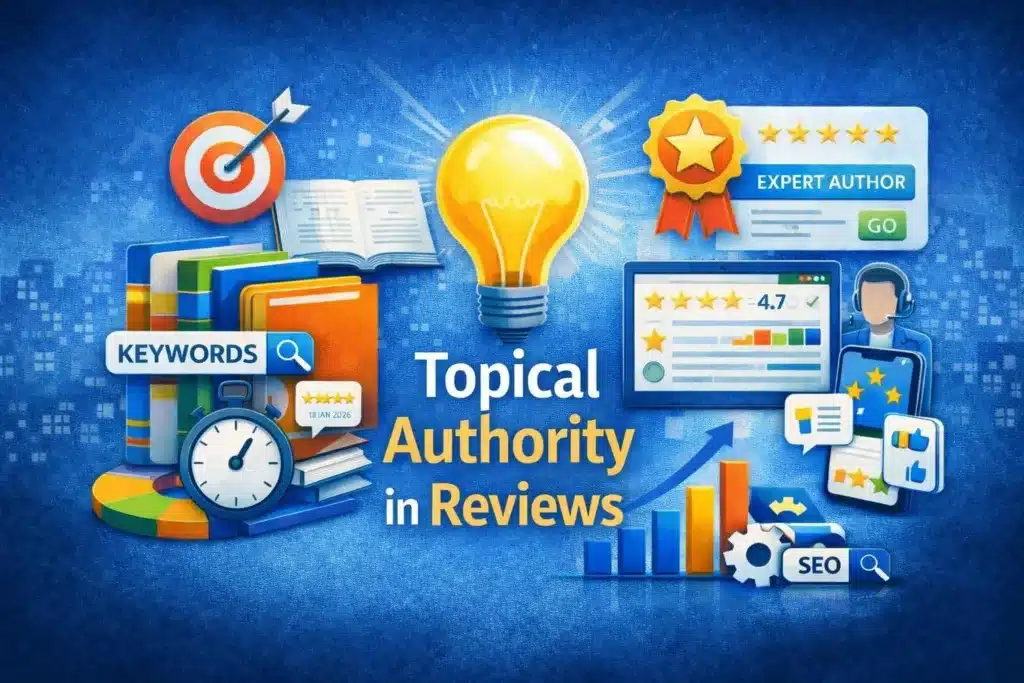

Individual keyword rankings remain useful SEO indicators, but they do not show the full strength of a website’s subject coverage. Building authority around a topic requires useful, accurate, interconnected resources that address the different questions potential customers ask as they research and evaluate a solution.
WSI Digital’s comprehensive SEO services approach reflects this broader model by combining content SEO, technical SEO, internal linking, user intent, authoritative evidence, and cross-platform visibility rather than treating rankings as an isolated activity.
What Does Topical Authority Mean?
Topical authority is best treated as an SEO strategy concept, not a single Google ranking factor or numerical score. It describes how comprehensively and credibly a website covers subjects that matter to its audience.
A strong topic ecosystem might contain:
| Content Type | Purpose |
| Core service page | Defines the primary solution |
| Educational blogs | Answer early-stage questions |
| Comparison content | Helps prospects evaluate options |
| Case studies | Demonstrate relevant experience |
| FAQs | Address narrower questions |
| Supporting resources | Add useful depth |
The goal is not to publish dozens of articles around every keyword variation. It is to answer worthwhile questions without creating unnecessary duplication.
Why One Strong Ranking Isn’t Enough
One highly ranked page can attract useful traffic, but buyers rarely make decisions based on one search alone. They may research a problem, compare solutions, investigate a company, read reviews, and return through a different query before contacting a provider.
Creating connected resources allows your business to support more of that journey.
WSI Digital’s building page authority through internal linking highlights the importance of logical contextual links between related resources rather than leaving important pages isolated.
Build Topic Coverage Around Real Buyer Questions
Effective topic coverage starts with audience needs rather than a quota for new content. Identify the core problems surrounding an important service, then map the questions people ask at different stages.
Potential questions include:
- What is this service?
- When is it needed?
- What problem does it solve?
- What alternatives exist?
- What does implementation involve?
- What should a buyer evaluate?
- What mistakes should they avoid?
- What should happen next?
WSI Digital’s search intent mapping framework can help separate informational, commercial, transactional, and navigational needs so each page has a clear role.
Internal Linking Helps Connect the Topic
Internal links give readers pathways between related information and help search engines discover and contextualize pages. They are most useful when the destination naturally expands the current discussion.
Strong internal linking can:
- Connect supporting articles to primary pages
- Prevent useful resources from becoming isolated
- Help visitors explore related questions
- Reinforce relationships between topics
- Direct users toward appropriate next steps
The on-page SEO services offered by WSI Digital incorporate internal linking alongside content structure, headings, metadata, and other page-level elements.
Authority Requires Evidence, Not Just Volume
Publishing frequently does not automatically demonstrate expertise. Strong content should be accurate, useful, appropriately sourced, and supported by genuine knowledge of the subject.
For this blog’s external authority source, Semrush’s guidance on topical authority provides additional context around building comprehensive subject coverage and organizing related content.
Practical credibility signals can include:
- Expert authorship
- First-hand examples
- Original data
- Reliable citations
- Case studies
- Relevant professional credentials
- Accurate publication and update dates
These elements make content more valuable independently of any particular ranking outcome.
Audit Your Existing Topic Coverage
A topical content audit can reveal gaps without encouraging unnecessary publishing. Start with an important service and evaluate the ecosystem around it.
Ask:
- Is there a clear primary page?
- Have we addressed common early-stage questions?
- Is there useful comparison or evaluation content?
- Do we demonstrate real experience?
- Are related pages connected?
- Are multiple pages competing unnecessarily for the same purpose?
- Is older information still accurate?
- Is there a logical conversion path?
The answers can help prioritize new content, updates, consolidation, or improved internal linking.
FAQs
Is topical authority a direct ranking factor?
It is more accurate to describe topical authority as a strategic concept. Google uses many systems and signals to rank pages rather than one simple topical-authority score.
How many articles are needed?
There is no required number. Cover important customer questions thoroughly without creating thin or repetitive pages.
Can existing articles build stronger topical coverage?
Yes. Refreshing, consolidating, and connecting existing resources may be more appropriate than continually publishing new ones.
Build a Useful Resource, Not Just a Keyword Library
The strongest topic strategy is one that makes your website more useful to the people you want to reach. Rankings remain important, but they should support the larger goal of helping potential customers understand their problem, evaluate solutions, and trust your expertise.
If your existing content has grown without a clear structure, talk with WSI Digital and identifying the topic gaps most closely connected to your business goals.